AI Programming & Development: Career Options, Skills & Courses After 12th
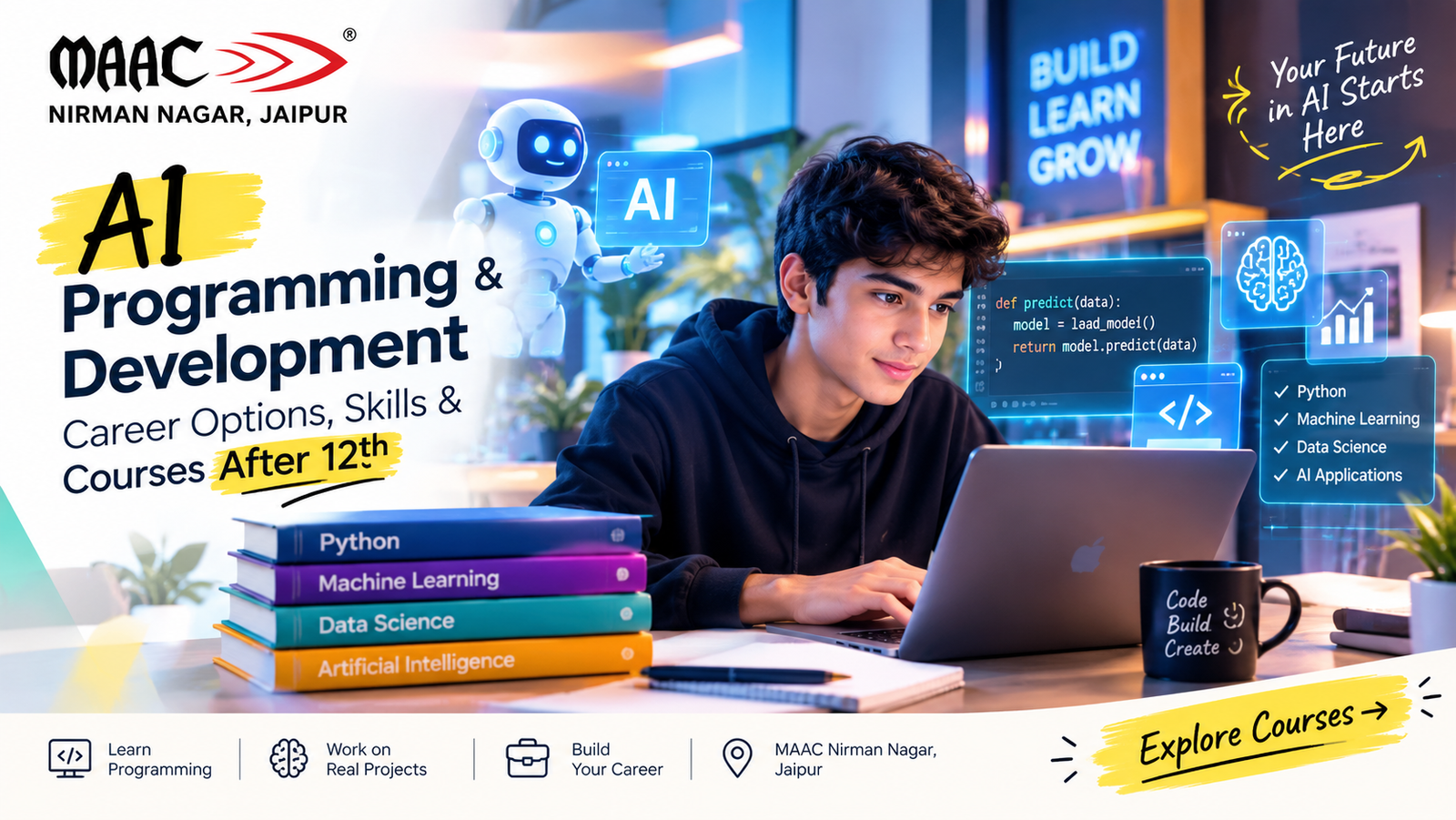
Artificial Intelligence (AI) is becoming an important part of modern technology. From chatbots and recommendation systems to image generation and intelligent applications, AI is changing how people interact with digital products.
For students exploring career options after Class 12, Artificial Intelligence and AI Programming & Development can be an exciting field to learn about.
But what does an AI developer actually do? Which skills should you learn? And how can you start exploring AI courses in Jaipur?
This guide covers the basics to help you understand the field and decide whether it matches your interests.
What Is Artificial Intelligence?
Artificial Intelligence refers to technologies that enable computer systems to perform tasks that typically require human-like intelligence, such as recognising patterns, understanding language, making predictions and generating content.
AI is used in many areas, including:
- Chatbots and virtual assistants
- Image and video generation
- Voice recognition
- Personalised recommendations
- Data analysis
- Robotics and automation
- Intelligent software applications
AI combines programming, mathematics, data and problem-solving to build systems that perform useful tasks.
What Is AI Programming & Development?
AI programming and development involves creating software applications that use AI technologies.
Depending on the project, developers may work with programming languages, datasets, machine learning models, APIs and AI frameworks.
For example, an AI developer might build a chatbot that answers customer questions, create a system that categorises images or develop an application that analyses information.
AI development is not just about using AI tools. It also involves understanding how software works and how AI features can be designed, tested and integrated into applications.
Can You Learn AI After 12th?
Yes. Students who have completed Class 12 can explore AI and programming courses, depending on the eligibility requirements of the particular program.
You don't need to be an AI expert before starting. However, being curious about technology and willing to practise problem-solving can help.
Students should also understand that more advanced AI development often requires a foundation in programming, mathematics, statistics and data handling.
A structured learning path can help beginners develop these skills step by step.
What Do You Learn in an AI Programming Course?
The curriculum varies between institutes and programs, but AI-focused training may include the following areas.
1. Programming Fundamentals
Programming helps you give instructions to a computer and build software applications.
Python is widely used in AI and data science because of its readable syntax and extensive ecosystem of libraries.
Students may learn variables, conditions, loops, functions, data structures and basic problem-solving.
2. Data Handling
AI systems often rely on data to identify patterns and produce useful outputs.
Learning how to collect, organise, clean and analyse data can help students understand how AI applications work.
3. Machine Learning Basics
Machine learning is a branch of AI in which systems learn patterns from data to make predictions or decisions.
Students exploring this area may learn about training data, model evaluation, classification, regression and the limitations of machine learning systems.
4. Generative AI
Generative AI can create new content, including text, images, audio and code.
Students may explore how AI models are used, how to write effective prompts and how AI capabilities can be integrated into applications.
5. AI Tools and Frameworks
Depending on the course, students may be introduced to programming libraries, AI APIs and development frameworks.
The specific tools should be checked against the current course curriculum before enrolling.
6. Practical Projects
Projects help turn concepts into practical skills.
Examples include building a simple chatbot, creating an image classification prototype or developing a basic application that uses an AI API.
The aim is to understand how different components work together to solve a problem.
What Skills Do You Need for AI Development?
Students interested in AI can gradually develop several important skills.
Programming: Learn how to write, read and debug code.
Logical thinking: Break complex problems into smaller steps.
Mathematics: Build a foundation in algebra, probability and statistics as you progress.
Data analysis: Understand how data is organised and interpreted.
Problem-solving: Test ideas, identify errors and improve solutions.
Continuous learning: AI technologies evolve quickly, so staying curious and learning new concepts is important.
You don't need to master all these skills on day one. Consistent practice makes a difference.
Career Options in Artificial Intelligence
AI is a broad field, and different roles require different levels of education, experience and technical knowledge.
AI Developer
Builds software applications that use AI models, services or APIs.
Machine Learning Engineer
Develops, trains, evaluates and deploys machine learning systems. These roles often require stronger programming and mathematical foundations.
Data Analyst
Works with data to identify patterns, prepare reports and support business decisions. Advanced AI knowledge is not always required for entry-level data analyst roles.
Python Developer
Uses Python to build software, automate tasks and develop applications. Python is also widely used in AI projects.
AI Application Developer
Integrates AI capabilities into websites, mobile applications or business software.
AI Researcher
Explores new AI methods and techniques. Research positions often require advanced academic qualifications and specialised expertise.
Your career options will depend on the skills you build, the projects you complete and the qualifications required for the role.
AI Programming vs Using AI Tools
These two activities are related, but they are not the same.
| Using AI Tools | AI Programming & Development |
|---|---|
| Using existing AI applications | Building software that uses AI |
| Writing prompts | Writing and debugging code |
| Generating content | Integrating AI models or APIs |
| Using ready-made features | Testing and evaluating AI functionality |
| Often accessible to beginners | Usually requires technical learning |
Both can be valuable skills. The right path depends on whether you want to use AI in your current work or build technology with it.
Why Practical Projects Matter
Watching tutorials can help you understand concepts, but building projects lets you apply them.
Beginners could start with projects such as:
- A basic chatbot
- A simple FAQ assistant
- A Python-based data analysis project
- An image classification prototype
- An application that uses a generative AI API
As you progress, document your work and explain the problem, your approach and the results.
A project portfolio can help demonstrate your skills when applying for further training, internships or suitable entry-level opportunities.
How to Choose an AI Course in Jaipur
If you're searching for an AI programming course in Jaipur, compare the curriculum and learning approach before enrolling.
Check the Curriculum
Look for clear information about programming, AI fundamentals, practical work and the technologies taught.
Understand the Entry Requirements
Confirm whether the course is suitable for beginners and whether any prior programming or mathematics knowledge is expected.
Look for Hands-On Projects
Ask what students actually build during the course and whether they receive feedback on their work.
Check Faculty and Mentorship
Guidance can help you understand difficult concepts and improve your projects.
Review Career Support
Ask what career guidance, portfolio support or placement assistance is available. Avoid assuming that completing a course guarantees a job.
Confirm the Course Details
Check duration, fees, eligibility, learning format and the current curriculum directly with the institute.
Is AI Programming a Good Career After 12th?
AI programming may suit students who enjoy technology, coding, logical thinking and solving problems.
However, it is important to understand that becoming an AI developer takes more than learning a few AI tools. Programming fundamentals, practical projects and continuous learning are essential.
If you're unsure whether AI development is right for you, start by learning basic programming and building a small project. This can help you discover whether you enjoy the process.
Explore AI Programming & Development at MAAC Nirman Nagar, Jaipur
Students interested in technology-focused learning can enquire about the AI Programming & Development program at MAAC Nirman Nagar, Jaipur.
Before enrolling, ask the centre about the current curriculum, programming languages, AI tools, project work, eligibility and career support.
MAAC Nirman Nagar also offers programs in other creative fields, including:
- 3D Animation & Modelling
- VFX & Visual Effects
- Graphic Design & UI/UX
- Digital Content Creation
- Motion Graphics & Compositing
- AI-Powered Digital Marketing
Explore the options and choose a learning path that fits your interests and long-term goals.
Frequently Asked Questions
Can I learn AI after 12th?
Yes. You can explore beginner-friendly AI and programming courses after Class 12, subject to each program's eligibility requirements.
Do I need coding to become an AI developer?
Yes, programming is an important skill for AI development. Python is a common starting point, while more advanced roles may require additional languages, frameworks and mathematical knowledge.
Which programming language is useful for AI?
Python is widely used because it has a large ecosystem of libraries and tools for machine learning, data science and AI application development.
What jobs can I get after learning AI?
Depending on your skills, education and experience, possible career paths include Python Developer, AI Application Developer, Data Analyst and, with further specialised training, Machine Learning Engineer.
Is an AI course enough to get a job?
A course can provide a foundation, but employment depends on your skills, projects, qualifications, experience and the requirements of the role.
How do I choose an AI institute in Jaipur?
Compare the curriculum, teaching approach, hands-on projects, faculty, eligibility requirements and career support before making a decision.
Start Exploring Artificial Intelligence
Artificial Intelligence brings together programming, data, technology and problem-solving. For students after Class 12, learning the fundamentals can be the first step towards understanding this evolving field.
Start with programming, practise regularly, build projects and learn how AI can solve real problems.
Learn the fundamentals. Build practical projects. Explore the possibilities of AI.
