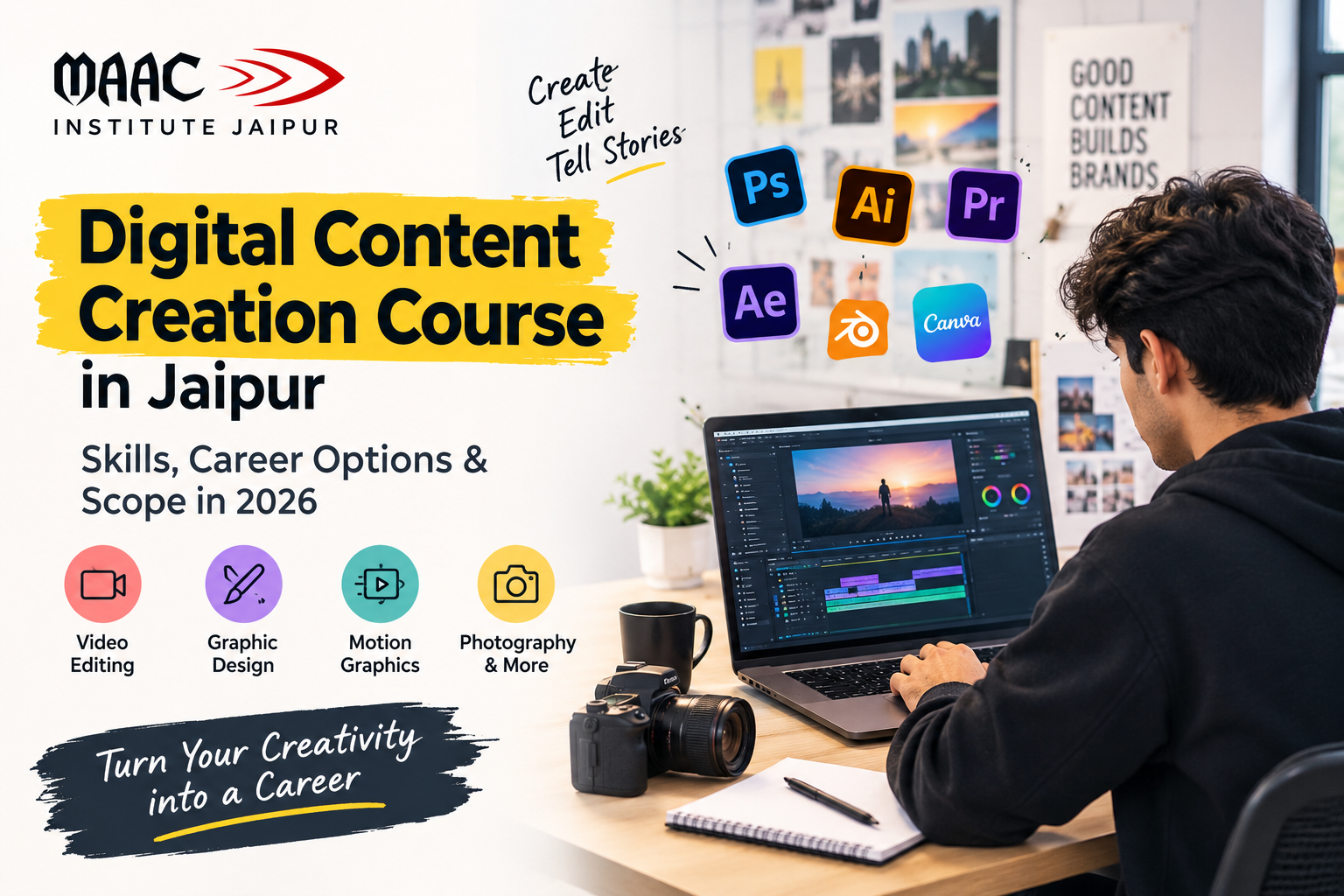
Digital Content Creation Course in Jaipur: Skills, Career Options & Scope in 2026
The way people consume content has changed significantly. From Instagram Reels and YouTube videos to animated advertisements and branded social media posts, digital content has become an important part of how businesses communicate with their audiences.
This growing demand for engaging visual content has created opportunities for people interested in video production, graphic design, animation, photography and digital storytelling.
If you enjoy creativity and want to turn your interest into a professional skill, exploring a Digital Content Creation Course in Jaipur can be a useful starting point. This guide explains what digital content creation involves, which skills you can learn, the career options available and how to choose the right training programme.
What Is Digital Content Creation?
Digital content creation is the process of planning, producing and editing content for online platforms and digital media.
The goal is to communicate a message, share information, entertain an audience or promote a product or service through engaging digital formats.
Examples of digital content include:
- Instagram posts, Stories and Reels
- YouTube videos and short-form videos
- Promotional videos and advertisements
- Motion graphics and animated content
- Product photography and video shoots
- Educational videos and explainers
- Digital graphics, banners and illustrations
- Branded content for websites and social media
Businesses, content creators, advertising agencies and media companies use these formats to connect with their audiences.
Why Choose Digital Content Creation as a Career in 2026?
Digital platforms have made visual communication important across industries. Companies need content to introduce their products, explain services, communicate their brand identity and engage with customers.
Here are some reasons to explore this career path.
1. Opportunities Across Different Industries
Digital content skills can be useful in advertising agencies, media production companies, e-commerce businesses, educational organisations, entertainment companies and marketing teams.
2. A Combination of Creativity and Technology
Content creation combines creative thinking with practical technical skills. You may work with video editing, graphic design, animation, storytelling and digital production tools.
3. Different Career Paths
Depending on your interests and the skills you develop, you can explore opportunities in video production, social media content, motion graphics, digital design or multimedia production.
4. Opportunities to Build a Portfolio
You can demonstrate your abilities through original projects, edited videos, promotional creatives and other examples of your work. A strong portfolio helps employers and clients understand what you can create.
What Do You Learn in a Digital Content Creation Course?
A structured course may cover different areas of digital media production. The exact curriculum depends on the institute and programme, so students should review the syllabus before enrolling.
1. Content Planning and Storytelling
Before producing content, it is important to understand the target audience, purpose and message.
You can develop skills in idea generation, basic scripting, visual storytelling, content planning and organising creative projects.
2. Graphic Design Fundamentals
Graphic design helps you communicate ideas through images, typography, colours and layouts.
Important concepts include:
- Colour theory and typography
- Layout and composition
- Visual hierarchy
- Branding and visual identity
- Social media creative design
These fundamentals are useful when creating thumbnails, promotional graphics, advertisements and branded content.
3. Video Editing
Video editing involves selecting footage, arranging clips, adjusting timing and creating a clear visual sequence.
Depending on the programme, training may introduce editing software such as Adobe Premiere Pro and other industry-relevant tools.
4. Motion Graphics and Animation
Motion graphics adds movement to text, illustrations, logos and other visual elements.
These techniques are commonly used in promotional videos, animated advertisements, title sequences and explainer content.
5. Digital Media Production
Content production may involve planning a shoot, understanding framing and lighting, recording suitable footage, organising media files and preparing content for different platforms.
Practical exercises help learners understand how individual production stages work together.
6. AI-Assisted Content Creation
AI tools can support brainstorming, research, script outlines and creative experimentation. However, effective content still requires human judgment, originality, fact-checking and quality control.
Learning when to use AI—and when not to rely on it—is an increasingly useful part of a modern creative workflow.
Career Opportunities After a Digital Content Creation Course
After developing relevant skills and building a portfolio, you can explore several career paths.
Digital Content Creator
Creates videos, graphics and other digital material for online platforms, brands or personal channels.
Video Editor
Edits recorded footage, adds transitions and audio, and prepares videos for advertising, entertainment or online publishing.
Motion Graphics Designer
Creates animated typography, graphic elements, logo animations and visual sequences for digital media.
Social Media Content Designer
Develops visual content for social media campaigns, including posts, stories, thumbnails and promotional creatives.
Multimedia Designer
Combines different media formats, such as graphics, video, animation and audio, to communicate information.
Video Production Assistant
Supports video production through preparation, equipment coordination, shoot assistance and media organisation.
The roles available to you will depend on your practical abilities, portfolio, experience and the requirements of individual employers.
Which Software Should You Learn?
The tools you need depend on the type of content you want to produce.
| Tool | Common use |
| Adobe Photoshop | Image editing and digital graphics |
| Adobe Illustrator | Vector graphics and illustrations |
| Adobe Premiere Pro | Video editing |
| Adobe After Effects | Motion graphics and visual effects |
| Blender | 3D modelling and animation |
| Canva | Accessible graphic design and social media content |
You do not need to master every tool at once. Start with the tools that match your interests and develop a solid understanding of the underlying creative principles.
How to Build a Strong Digital Content Portfolio
A portfolio is an important way to demonstrate your skills to potential employers and clients.
Here are five practical steps to get started.
Step 1: Choose a content category. Decide whether you want to focus on video editing, social media design, motion graphics or a combination of creative disciplines.
Step 2: Create sample projects. Develop a promotional video, a social media campaign, a YouTube thumbnail set or a short animated sequence.
Step 3: Show your process. Explain the purpose of each project, the tools you used and the creative decisions you made.
Step 4: Improve your work. Review your projects, identify weaknesses and revise them based on feedback.
Step 5: Organise your portfolio. Present your best work clearly so that recruiters and clients can quickly understand your capabilities.
Practical projects are valuable because they demonstrate what you can do rather than simply listing the software you know.
How to Choose the Right Digital Content Creation Course in Jaipur
Before selecting an institute, consider the following factors.
- Course curriculum: Check which creative subjects and software tools are included.
- Practical training: Find out how much time is dedicated to hands-on assignments and projects.
- Portfolio development: Check whether students get opportunities to create work they can showcase.
- Trainer guidance: Look for feedback and support that help you improve your skills.
- Career guidance: Ask about portfolio reviews, interview preparation and placement assistance, if offered.
- Student work: Review examples of projects created by learners to understand the practical learning environment.
Choosing a course based on its curriculum and practical learning approach can help you make a more informed decision.
Explore Digital Content Creation at MAAC Jaipur
If you want to explore creative fields such as animation, visual effects, graphic design, motion graphics and digital media, MAAC Institute Jaipur offers programmes across several creative disciplines, including Digital Content Creation.
The institute’s website provides information about its courses and student work, which can help you explore the learning options available.
Before enrolling, review the relevant course curriculum and speak with the institute to understand the programme structure, practical assignments, eligibility requirements and current admission details.
Interested in developing your creative skills?
Visit MAAC Institute Jaipur to explore the available courses and submit an admission enquiry.
You can also visit the institute at 876, Gautam Marg, Nirman Nagar, Jaipur, Rajasthan 302019, to learn more about its programmes.
Frequently Asked Questions
1. What is a digital content creation course?
A digital content creation course teaches skills related to planning, designing, producing and editing digital media, depending on the programme curriculum.
2. Can I pursue digital content creation after Class 12?
Yes, you can explore relevant courses after Class 12, subject to the eligibility requirements of the particular programme.
3. Is digital content creation a good career option?
It can be a suitable career path for people interested in visual communication, video production, design and digital media. Career opportunities depend on your skills, portfolio and experience.
4. Which software is useful for digital content creation?
Photoshop, Illustrator, Premiere Pro, After Effects, Blender and Canva are examples of tools used for different types of creative work.
5. Do I need prior experience to learn digital content creation?
Not necessarily. Some programmes are designed for beginners, but you should check the entry requirements and curriculum before applying.
6. What is more important: software knowledge or practical skills?
Both matter. Software knowledge helps you operate the tools, while practical skills, creativity, problem-solving and a strong portfolio help you produce effective content.
Conclusion
Digital content creation brings together creativity, technology and storytelling. From video editing and social media graphics to motion design and multimedia production, it offers different ways to develop a professional creative skill set.
If you are exploring creative courses in Jaipur, begin by identifying the type of work you enjoy, reviewing the available curricula and choosing a programme that supports practical learning.
With consistent practice, feedback and a well-developed portfolio, you can take meaningful steps towards a career in digital media and content production.
