Motion Graphics vs Graphic Design: Which Career Is Right for You?
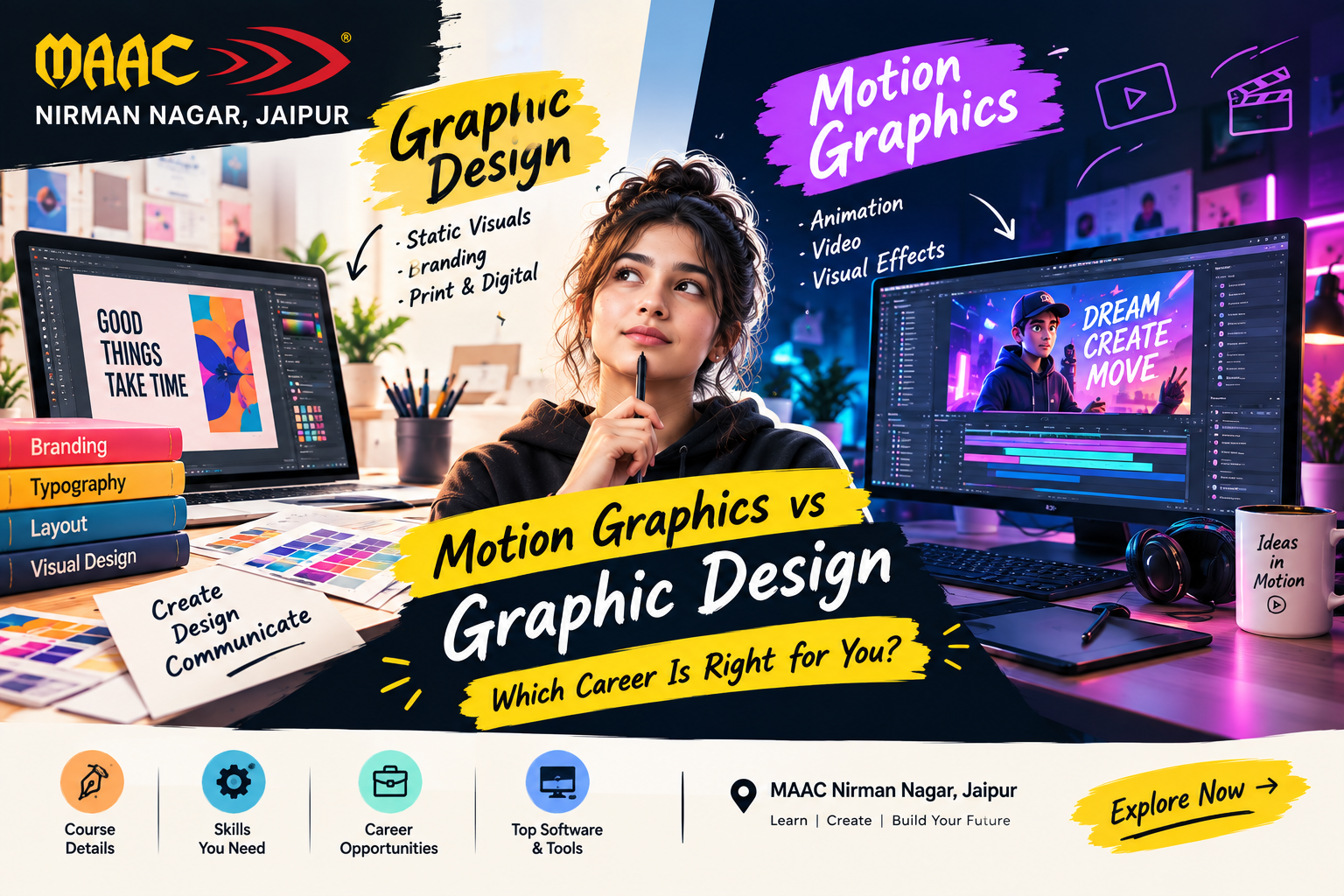
If you're a creative student wondering what to do after 12th, you may have come across two popular design fields: Graphic Design and Motion Graphics.
Both involve creativity, visual communication and design. However, the way they are used and the skills required can be quite different.
A graphic designer may create a logo, poster, social media campaign or brand identity, while a motion graphics designer can take visual elements and bring them to life through animation and movement.
So, Motion Graphics vs Graphic Design — which one should you choose?
The answer depends on your interests, the type of work you enjoy and the career direction you want to explore.
Let's understand the difference.
What Is Graphic Design?
Graphic design is the process of communicating an idea or message through visual elements.
Graphic designers work with:
- Typography
- Colours
- Images
- Illustrations
- Layouts
- Shapes
- Branding
- Visual hierarchy
Graphic design is used across advertising, branding, social media, websites, packaging, marketing and many other areas.
For example, a designer may create:
- Logo
- Brochure
- Poster
- Social media creative
- Brand identity
- Advertisement
- Packaging design
- Website graphics
The main objective is to communicate a message clearly through visual design.
What Is Motion Graphics?
Motion graphics takes graphic design and adds movement, animation and time.
Instead of a static poster, motion graphics can turn the same visual concept into an animated video.
Motion graphics can include:
- Animated typography
- Logo animation
- Explainer videos
- Social media videos
- Promotional videos
- Title sequences
- Animated illustrations
- Visual effects
- Product animations
For example:
Graphic Design: A static brand advertisement.
Motion Graphics: The same advertisement with animated text, graphics, transitions and visual effects.
Motion Graphics vs Graphic Design: The Main Difference
The simplest way to understand the difference is:
Graphic Design = Visual Communication
Motion Graphics = Visual Communication + Movement
Here's a broader comparison:
| Graphic Design | Motion Graphics |
|---|---|
| Static visual communication | Animated visual communication |
| Posters | Animated videos |
| Logos | Logo animation |
| Branding | Animated branding |
| Social media graphics | Social media videos |
| Typography | Animated typography |
| Packaging | Product animation |
| Print & digital design | Video & digital media |
However, the two fields are closely connected.
A strong understanding of graphic design can provide a useful foundation for learning motion graphics.
Why Is Motion Graphics Becoming Important?
People consume a huge amount of visual content through digital platforms.
Brands and creators use short-form videos, advertisements, social media content and animated graphics to communicate ideas.
Motion graphics can be used in:
- Social media
- Digital advertising
- YouTube
- OTT content
- Corporate videos
- Brand campaigns
- Explainer videos
- Presentations
- Events
- Entertainment
This makes motion design a useful skill for professionals working in digital content and creative industries.
What Do You Learn in Graphic Design?
A graphic design course can introduce students to fundamental design concepts.
Typography
Understanding fonts, hierarchy, spacing and readability.
Colour Theory
Learning how colours work together and how they influence visual communication.
Composition
Understanding layout, balance, alignment and visual hierarchy.
Branding
Creating consistent visual identities for brands and businesses.
Digital Design
Creating graphics for websites, social media and digital marketing.
Visual Communication
Learning how to communicate an idea effectively through design.
What Do You Learn in Motion Graphics?
Motion graphics requires many of the same design fundamentals, along with animation and video skills.
Students can explore:
Animation Principles
Understanding timing, movement, transitions and visual rhythm.
Animated Typography
Creating movement using text and typography.
Logo Animation
Turning static logos into animated brand elements.
Video Compositing
Combining multiple visual elements into a final composition.
Visual Effects
Adding effects and visual elements to enhance digital content.
Storytelling
Using movement, timing and visuals to communicate an idea.
Software Used in Graphic Design
Graphic designers commonly work with tools such as:
- Adobe Photoshop
- Adobe Illustrator
- Adobe InDesign
- Figma
- Other digital design tools
The exact software used depends on the type of design work.
Software Used in Motion Graphics
Motion graphics workflows can involve tools such as:
- Adobe After Effects
- Adobe Premiere Pro
- Adobe Photoshop
- Adobe Illustrator
- Blender
- Other animation and video tools
Learning software is useful, but understanding design and animation principles is equally important.
Skills Needed for Graphic Design
A successful graphic designer needs more than software knowledge.
Creativity
You need to develop different visual ideas for different communication problems.
Typography
Understanding how text works within a design is essential.
Colour Sense
Good colour choices can improve visual communication.
Composition
You need to understand how different elements work together within a layout.
Communication
A designer must understand what the client or brand wants to communicate.
Attention to Detail
Spacing, alignment and consistency can have a major impact on the final design.
Skills Needed for Motion Graphics
Motion graphics adds another layer of skills.
Animation
Understanding movement, timing and transitions.
Storytelling
Knowing how visuals can communicate an idea over time.
Timing
Understanding when elements should appear, move and disappear.
Visual Design
Strong graphic design fundamentals remain important.
Video Editing
Understanding how footage, sound and graphics work together can be useful.
Technical Skills
Motion graphics requires working with animation and compositing software.
Career Opportunities in Graphic Design
After developing your skills and building a portfolio, you can explore roles such as:
Graphic Designer
Creates visual content for brands, businesses and organisations.
Brand Designer
Works on logos, visual identities and brand systems.
Visual Designer
Creates visual experiences across digital platforms.
Creative Designer
Develops visual concepts for marketing and advertising.
Digital Designer
Creates graphics for digital platforms.
Social Media Designer
Creates visual content for social media campaigns.
Career Opportunities in Motion Graphics
Motion graphics can lead to different creative roles.
Motion Graphics Designer
Creates animated graphics for digital content, advertising and other media.
2D Motion Designer
Creates animations using illustrations, typography and graphic elements.
Video Designer
Combines video, graphics and animation to create digital content.
Visual Effects Artist
Works on visual effects and compositing depending on their specialization.
Multimedia Designer
Creates visual content across different digital formats.
Motion Art Director
With experience, professionals can move into roles involving creative direction and visual concepts.
Where Can Motion Graphics Designers Work?
Motion graphics skills can be used in:
Advertising Agencies
Creating animated advertisements and digital campaigns.
Digital Marketing Agencies
Developing social media videos, advertisements and promotional content.
Film & Entertainment
Working on titles, graphics and visual sequences.
YouTube & Digital Media
Creating animated content and visual assets for digital creators.
Corporate Companies
Creating presentations, explainer videos and internal communication content.
Freelance
Experienced designers can work with clients on individual projects.
Where Can Graphic Designers Work?
Graphic designers can find opportunities across:
- Advertising agencies
- Branding agencies
- Digital marketing companies
- Startups
- Media companies
- E-commerce businesses
- Corporate marketing teams
- Freelance projects
Almost every business needs some form of visual communication.
Which Is Easier: Graphic Design or Motion Graphics?
Neither should be considered simply "easy" or "difficult."
Graphic design generally begins with static visual communication.
Motion graphics adds additional concepts such as:
- Animation
- Timing
- Movement
- Video
- Compositing
This means motion graphics can require a broader technical workflow.
A student interested in motion graphics can benefit from first developing a strong understanding of graphic design fundamentals.
Can You Learn Motion Graphics After 12th?
Yes.
Students who have completed Class 12 can explore motion graphics courses depending on the eligibility requirements of the particular program.
You don't need to already know professional animation software.
A structured course can help you start with design fundamentals and gradually learn animation, compositing and motion design.
Can a Graphic Designer Become a Motion Graphics Designer?
Yes.
The two fields share several fundamental skills.
A graphic designer already understands concepts such as:
- Typography
- Colour
- Composition
- Layout
- Visual hierarchy
These skills can provide a foundation for motion graphics.
The designer then needs to develop additional skills in:
Animation + Timing + Video + Compositing + Motion Design
This is one reason why learning both graphic design and motion graphics can create a broader creative skill set.
How to Choose Between Graphic Design and Motion Graphics?
Consider what type of work you enjoy.
Graphic Design May Suit You If You Enjoy:
???? Branding
✏️ Typography
???? Social media graphics
????️ Posters and layouts
???? Advertising
???? Visual concepts
Motion Graphics May Suit You If You Enjoy:
???? Video content
✨ Animation
????️ Visual effects
???? Short-form content
???? Animated typography
???? Storytelling through movement
You can also learn both.
The skills complement each other, especially for digital marketing and content creation.
How to Choose a Course in Jaipur?
If you're looking for a graphic design or motion graphics course in Jaipur, compare the complete learning experience rather than only the course name.
Check the Curriculum
Look for design fundamentals, software training and practical projects.
Look at Practical Work
Find out whether students create actual projects during the course.
Check Portfolio Development
Your final portfolio should demonstrate what you can actually create.
Explore Software Training
Check which professional tools are included.
Consider Faculty & Mentorship
Feedback and guidance can help you improve faster.
Check Career Support
Look for career guidance, interview preparation and placement assistance.
Learn Motion Graphics & Graphic Design at MAAC Nirman Nagar, Jaipur
Students searching for motion graphics courses in Jaipur or graphic design courses in Jaipur can explore the relevant programs at MAAC Nirman Nagar.
The centre offers programs across creative and technology-focused fields, including:
- 3D Animation & Modelling
- VFX & Visual Effects
- Graphic Design & UI/UX
- Digital Content Creation
- Motion Graphics & Compositing
- AI-Powered Digital Marketing
- AI Programming & Development
Students can explore different creative fields and choose a learning path based on their interests and career goals.
Frequently Asked Questions
What is the difference between graphic design and motion graphics?
Graphic design primarily focuses on static visual communication, while motion graphics adds animation, movement and timing to visual elements.
Can I learn motion graphics after 12th?
Yes. Students can explore motion graphics courses after Class 12 depending on the eligibility requirements of the program.
Is graphic design a good career after 12th?
Graphic design can be a suitable career path for students interested in visual communication, creativity, branding and digital media.
Is motion graphics a good career?
Motion graphics can be an interesting career option for students interested in animation, video, visual storytelling and digital content.
What software is used for motion graphics?
Commonly used tools include Adobe After Effects, Premiere Pro, Photoshop, Illustrator and other animation or 3D software.
Do I need to know graphic design before learning motion graphics?
Not necessarily, but a foundation in graphic design can be very useful because motion graphics relies heavily on typography, composition, colour and visual design.
Which should I choose: graphic design or motion graphics?
Consider your interests. Graphic design focuses more on static visual communication, while motion graphics combines design with animation and movement. You can also develop skills in both.
Build Your Creative Career
Graphic design and motion graphics are not completely separate worlds.
They share the same foundation of visual communication, creativity and design, but motion graphics adds movement, animation and time.
If you're a student in Jaipur deciding what to learn after 12th, start by identifying the type of creative work you enjoy.
Whether you choose graphic design, motion graphics or eventually combine both, focus on learning the fundamentals, creating practical projects and building a strong portfolio.
Design it. Animate it. Bring ideas to life.
