VFX as a Career After 12th: Courses, Skills & Job Opportunities
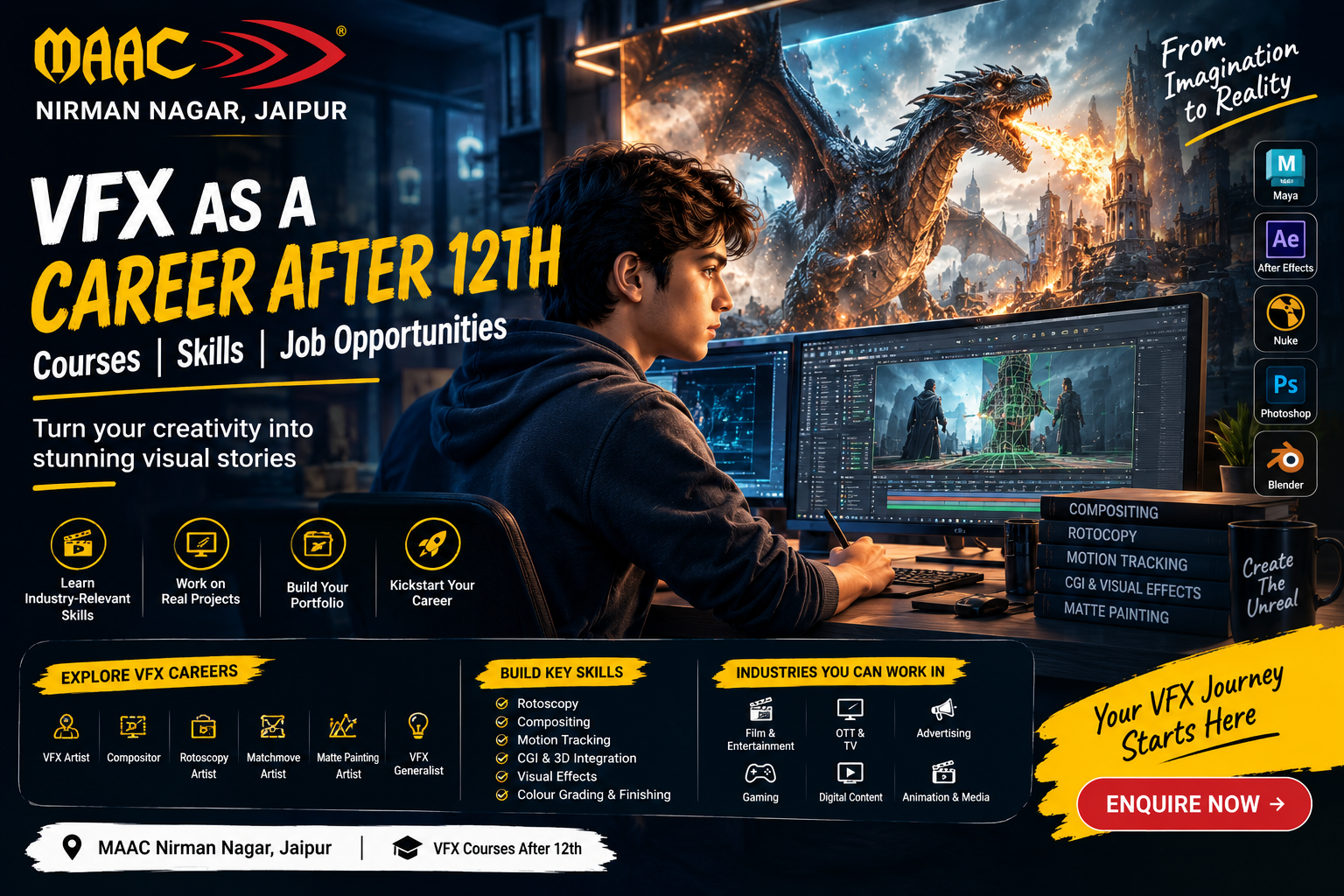
Are you interested in movies, visual effects, filmmaking, animation or digital creativity and wondering what to do after Class 12?
A career in VFX (Visual Effects) could be an option worth exploring.
From blockbuster movies and OTT series to advertisements, music videos and digital content, visual effects are used to create and enhance scenes that may be difficult or impossible to produce entirely with traditional filming.
For students interested in combining creativity and technology, VFX offers several areas of specialization and career opportunities.
But before choosing a VFX course after 12th, it's important to understand what VFX is, what you will learn, what skills are required and what career paths you can explore.
Let's take a look.
What Is VFX?
VFX stands for Visual Effects.
It involves creating, modifying or enhancing visual elements for films, videos and other digital productions.
A VFX artist may combine real footage with computer-generated elements to create a final scene.
For example, a production may shoot an actor against a simple background and later add a completely different environment using digital techniques.
VFX can be used in:
- ???? Films
- ???? OTT & television
- ???? Advertising
- ???? Gaming
- ???? Music videos
- ???? Digital content
- ???? Animation and filmmaking
Why Choose VFX After 12th?
If you're someone who enjoys visual storytelling, movies, technology and creative work, VFX can be an interesting career direction.
A VFX course allows students to develop both creative and technical skills.
Instead of only learning theory, students can work on visual projects and gradually understand how professional VFX workflows are created.
A career in VFX can also offer different specialization options, allowing students to focus on the area they enjoy most.
What Do You Learn in a VFX Course?
A VFX course can cover several stages of visual production.
1. Rotoscopy
Rotoscopy involves isolating people, objects or other elements from video footage.
It is commonly used when an element needs to be separated from its original background.
Students can learn techniques related to:
- Masking
- Subject isolation
- Edge refinement
- Matte creation
2. Compositing
Compositing is one of the most important parts of VFX.
It involves combining multiple elements into a single final shot.
For example:
Live footage + CGI + background + lighting + effects = Final VFX shot
The goal is to make all the elements look like they belong in the same scene.
3. Motion Tracking
Motion tracking allows artists to track the movement of a camera or object within footage.
This can help VFX artists accurately place digital elements into a moving scene.
It can be used for:
- CGI integration
- Digital objects
- Text
- Visual effects
- Camera tracking
4. CGI
Computer-Generated Imagery (CGI) allows artists to create digital objects, characters and environments.
CGI can be used for:
- Characters
- Creatures
- Buildings
- Vehicles
- Environments
- Special effects
CGI and VFX often work together in modern visual production.
5. Matte Painting
Matte painting is used to create or extend environments and backgrounds.
Artists can create digital landscapes, buildings or other environments and integrate them into live-action footage.
6. Colour & Visual Finishing
After different elements are combined, artists may need to adjust colours, lighting and contrast to make the shot look consistent.
This helps create a more natural and visually cohesive final result.
What Skills Do You Need for a VFX Career?
You don't have to be a professional VFX artist before joining a course.
However, certain qualities can help you develop faster.
Creativity
VFX involves finding creative ways to tell stories visually.
Attention to Detail
Small details such as edges, shadows, lighting and colour can affect the quality of a shot.
Patience
VFX projects often require multiple revisions and careful work.
Problem-Solving
Artists regularly need to find solutions to technical and visual challenges.
Visual Understanding
Understanding composition, perspective, lighting and colour can help you create more convincing visuals.
Which Software Is Used in VFX?
VFX workflows can involve different software depending on the specialization.
Some commonly used tools include:
- Autodesk Maya
- Adobe After Effects
- Adobe Photoshop
- Nuke
- Blender
- Silhouette
- Substance 3D tools
You don't necessarily need to learn every software package.
A good starting point is to understand the fundamentals of VFX and then specialize according to your career goals.
Career Options After a VFX Course
After developing technical skills and building a strong portfolio or showreel, students can explore different VFX roles.
VFX Artist
Works on creating and enhancing visual effects for digital productions.
Compositor
Combines different visual elements to create a final shot.
Rotoscopy Artist
Works on separating subjects and objects from footage.
Matchmove Artist
Tracks camera and object movement to help integrate digital elements into footage.
Matte Painting Artist
Creates digital backgrounds and environments.
VFX Generalist
Works across multiple areas of the VFX pipeline.
The role you pursue will depend on your specialization, skills and portfolio.
Where Can VFX Artists Work?
VFX is used across multiple industries.
Film & Entertainment
Movies and entertainment productions use VFX for environments, characters, effects and cinematic sequences.
OTT Platforms
Modern streaming productions also use visual effects in films, series and other content.
Advertising
Brands use CGI and VFX to create product advertisements and visually engaging campaigns.
Gaming
VFX and 3D skills can also be useful in game development and real-time production.
Digital Content
Creators and brands increasingly use animation, CGI and visual effects in online content.
Is VFX a Good Career After 12th?
For students who enjoy films, technology, creativity and visual storytelling, VFX can be a career worth exploring.
However, students should understand one important thing:
Completing a course alone doesn't build a career.
Your skills, practical experience and portfolio matter.
During your training, focus on:
- Creating practical projects
- Learning your chosen specialization
- Practising regularly
- Building a strong showreel
- Understanding professional workflows
- Getting feedback on your work
Your portfolio should demonstrate what you can actually create.
VFX Career: What Can You Expect?
The VFX industry has different roles with different skill requirements.
Your career progression can depend on:
- Your specialization
- Technical skills
- Quality of work
- Portfolio
- Showreel
- Practical experience
- Industry exposure
- Ability to learn new tools
Instead of focusing only on the title of your course, focus on what skills and projects you will be able to develop during the course.
How to Choose a VFX Course After 12th?
If you're comparing VFX courses in Jaipur, consider these factors before enrolling.
1. Course Curriculum
Check exactly what topics and specializations are covered.
2. Practical Training
Find out how much of the course involves hands-on work and projects.
3. Software
Check which professional tools and software you will learn.
4. Portfolio Development
Ask how the institute helps students create a portfolio or showreel.
5. Faculty & Mentorship
Good guidance can help you identify mistakes and improve your work.
6. Infrastructure
VFX training requires suitable computers, software and other technical resources.
7. Career Support
Look for career guidance, interview preparation and placement assistance.
VFX vs 3D Animation: Which Should You Choose?
This is one of the most common questions students have after 12th.
Although VFX and 3D animation can overlap, their focus is different.
| VFX | 3D Animation |
|---|---|
| Visual effects | 3D creation & animation |
| Compositing | Character animation |
| Rotoscopy | 3D modelling |
| Motion tracking | Rigging |
| CGI integration | Texturing |
| Live-action + digital elements | Digital characters & environments |
If you enjoy films, visual effects and combining real footage with digital elements, VFX may be suitable.
If you enjoy creating characters, 3D objects and digital worlds, 3D animation may be a better fit.
Can You Do a VFX Course After 12th in Jaipur?
Yes, students who have completed Class 12 can explore VFX courses depending on the eligibility criteria of the particular program.
For students searching for a VFX course after 12th in Jaipur, comparing curriculum, practical training, projects, software and career support can help in making the right decision.
Learn VFX at MAAC Nirman Nagar, Jaipur
Students looking for VFX courses in Jaipur can explore the VFX & Visual Effects program at MAAC Nirman Nagar.
Along with VFX, students can explore other creative and technology-focused areas, including:
- 3D Animation & Modelling
- VFX & Visual Effects
- Graphic Design & UI/UX
- Digital Content Creation
- Motion Graphics & Compositing
- AI-Powered Digital Marketing
- AI Programming & Development
Students can choose a learning path based on their interests and career goals.
Frequently Asked Questions
Can I do VFX after 12th?
Yes. Students who have completed Class 12 can explore VFX courses based on the eligibility requirements of the particular program.
Is VFX a good career after 12th?
VFX can be a suitable career option for students interested in visual storytelling, filmmaking, technology and digital production.
What jobs can I get after a VFX course?
Depending on your specialization and skills, you can explore roles such as VFX Artist, Compositor, Rotoscopy Artist, Matchmove Artist, Matte Painting Artist and VFX Generalist.
Is VFX difficult to learn?
VFX combines creative and technical skills, so it requires regular practice. Learning fundamentals and working on practical projects can help you progress.
Which is better, VFX or 3D Animation?
Neither is universally better. Your choice should depend on your interests. Choose VFX if you're interested in visual effects and compositing, while 3D animation may suit you if you enjoy modelling, characters and animation.
Which is the best VFX institute in Jaipur?
Compare institutes based on curriculum, practical training, software, faculty, projects, portfolio development, infrastructure and career support rather than choosing only based on advertisements.
Start Your VFX Journey
If you're passionate about movies, visual effects, animation and digital storytelling, a VFX course can help you turn that interest into practical skills.
Start by understanding the different VFX specializations, explore the tools used in the industry and choose a course that gives you opportunities to learn, practise and build a portfolio.
If you're searching for VFX courses in Jaipur after 12th, explore your options and choose a learning path that matches your interests and career goals.
Learn the craft. Create the visuals. Build your portfolio. Shape your creative career.
